| Password | Support | Support (%) | Structure | Structure (%) | Preference |
|---|---|---|---|---|---|
| Drug Discovery | |||||
| AR0518 | 21 | 12% (low) | 19 | 71% (high) | Structure-leaning |
| ES2006 | 21 | 12% (low) | 19 | 71% (high) | Structure-leaning |
| FR0313 | 22 | 33% (low) | 18 | 54% (mid) | Structure-leaning |
| IS2006 | 18 | 0% (low) | 22 | 96% (high) | Structure-leaning |
| IT1112 | 21 | 12% (low) | 19 | 71% (high) | Structure-leaning |
| JK0901 | 25 | 62% (mid) | 15 | 38% (mid) | Support-leaning |
| LC1234 | 26 | 67% (high) | 14 | 21% (low) | Support-leaning |
| NA1029 | 22 | 33% (low) | 18 | 54% (mid) | Structure-leaning |
| NK7306 | 26 | 67% (high) | 14 | 21% (low) | Support-leaning |
| PH0513 | 30 | 88% (high) | 10 | 4% (low) | Support-leaning |
| TO8721 | 30 | 88% (high) | 10 | 4% (low) | Support-leaning |
| Environmental Visualization | |||||
| AD0517 | 21 | 12% (low) | 19 | 71% (high) | Structure-leaning |
| AS6699 | 26 | 67% (high) | 14 | 21% (low) | Support-leaning |
| DA0427 | 24 | 54% (mid) | 16 | 42% (mid) | Balanced |
| EL4269 | 23 | 50% (mid) | 17 | 50% (mid) | Balanced |
| GA0622 | 19 | 8% (low) | 21 | 92% (high) | Structure-leaning |
| NT4456 | 21 | 12% (low) | 19 | 71% (high) | Structure-leaning |
| SE1215 | 31 | 100% (high) | 9 | 0% (low) | Support-leaning |
| TS1234 | 28 | 83% (high) | 12 | 17% (low) | Support-leaning |
| Public Health | |||||
| LD0904 | 18 | 0% (low) | 22 | 96% (high) | Structure-leaning |
| LE1709 | 22 | 33% (low) | 18 | 54% (mid) | Structure-leaning |
| LE8134 | 22 | 33% (low) | 18 | 54% (mid) | Structure-leaning |
| NH9122 | 24 | 54% (mid) | 16 | 42% (mid) | Balanced |
| NY1950 | 26 | 67% (high) | 14 | 21% (low) | Support-leaning |
| RE4743 | 30 | 88% (high) | 10 | 4% (low) | Support-leaning |
4. Mentoring Style
Does my mentoring style focus on structure or support?
The Mindset(s)
Authoritative mentoring blends two things at once:
- Support: warmth, care, and responsiveness toward your mentees.
- Survey item: “How important is it to you, as a mentor, to build good relationships with your mentees?”
- Structure: clear routines, expectations, and follow-through.
- Survey item: “How important is it to you, as a mentor, to set clear expectations for how your team works together?”
Polarity: Structure ↔︎ Support.
This chapter looks at structure and support through two lenses. Your dimensional preference comes from a 40-point budget, where valuing one more means valuing the other less, so it captures which way you lean. Your type comes from your rated skill on structure- and support-related mentoring competencies, which are measured independently, so you can be high or low on each.
Measures:
- Mentoring Style Values Inventory (importance-rated; adapted from Ertesvåg, 2011). Eight items, four per subscale, rated 1–10 under a 40-point budget.
- Mentoring Competency Assessment (Fleming et al., 2013), skill-rated 1–7. Selected items form an independent support-skill and structure-skill composite (see Your Type).
Your Dimensional Preference
Because the eight budget items share 40 points, Support and Structure trade off against each other: every point you add to one you take from the other, and the two always total 40. So this score is not “how much” of each you value in absolute terms, but which way you lean.
Use your password to find your score(s).
How your Preference is decided
Your Preference comes from comparing your two percentiles, not your raw point totals. If your Support percentile sits more than 20 points above your Structure percentile you are Support-leaning; more than 20 points below, Structure-leaning; within 20 points of each other, Balanced.
Raw points would be misleading. Almost everyone in this cohort spends more than half the 40-point budget on support, so judging against an even 20/20 split would call nearly everyone support-leaning — a fact about the items, not about you. Comparing percentiles asks the more useful question: which way you lean relative to your peers.
The two percentiles will always look like opposites, because Structure is 40 minus Support. That mirroring is arithmetic, not a finding about you.
Locate Your Preference
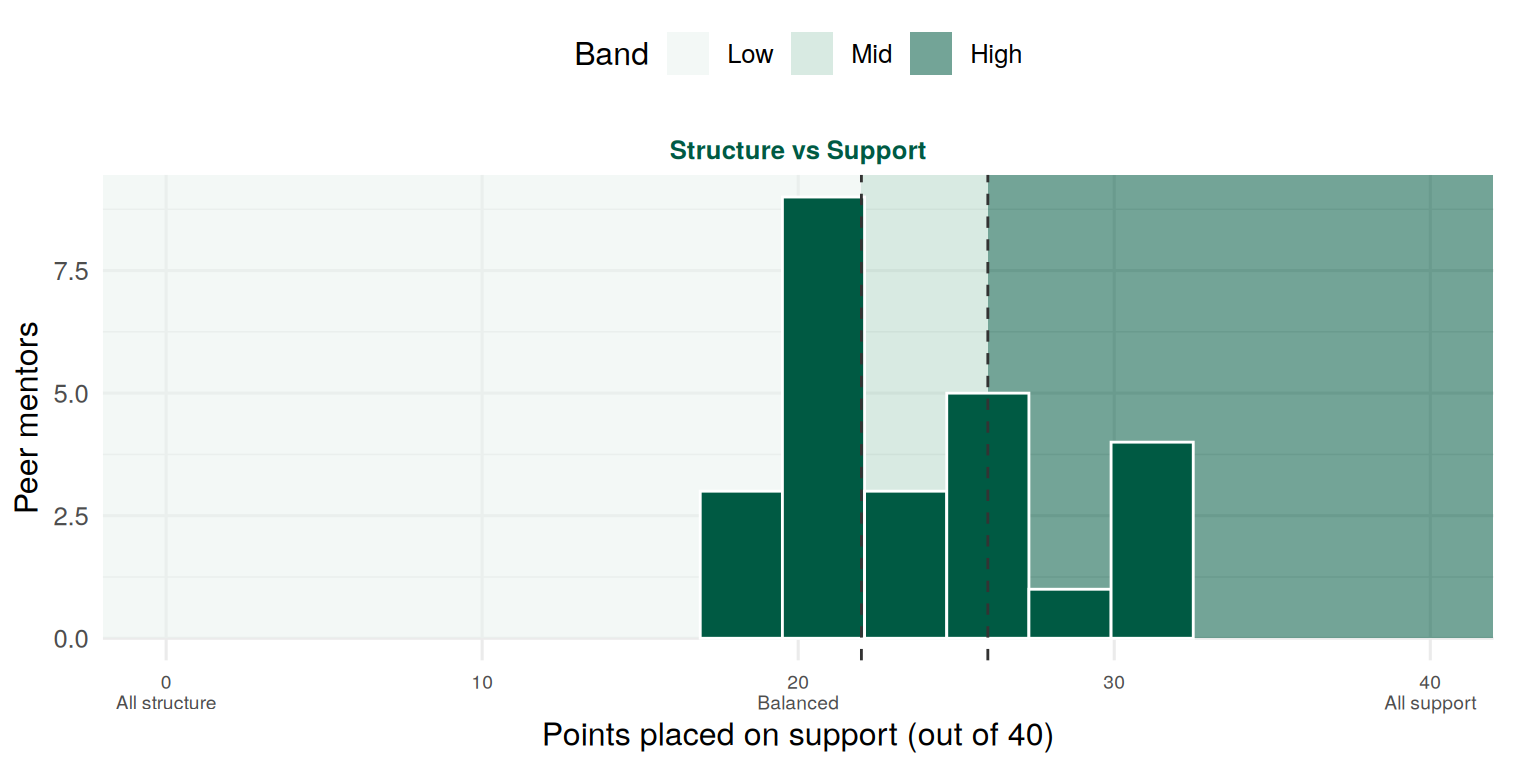
Locate your preference relative to other peer mentors! The axis is the points you placed on support (structure is 40 minus that): the far left is all structure, the far right is all support, and 20 is a balanced split.
Your Type
Structure and support are two dimensions that result in four mentoring styles. Neither dimension is “good” or “bad” on its own; it is the combination that describes how you show up as a mentor:
| Low Support | High Support | |
|---|---|---|
| High Structure | Authoritarian: high expectations, little warmth. Clear and demanding, but mentees may not feel safe asking for help. | Authoritative: high expectations and high warmth. Clear structure that mentees experience as being on their side. |
| Low Structure | Uninvolved: low on both. Mentees are largely left to themselves. | Permissive: warm and caring, but loose on expectations. Mentees feel supported but may drift. |
Unlike the budget above, your type comes from how skilled you feel at two independent sets of mentoring competencies (from the Mentoring Competency Assessment), so all four combinations are possible.
- Support skill: assessing mentee knowledge, estimating mentee ability, enhancing mentee skills, and building confidence.
- Structure skill: setting clear relationship expectations, aligning expectations, and helping establish work/life balance.
| Password | Support skill | Support skill (%) | Structure skill | Structure skill (%) | Type |
|---|---|---|---|---|---|
| Drug Discovery | |||||
| AR0518 | 2.25 | 0% (low) | 3.33 | 8% (low) | Uninvolved |
| ES2006 | 4.50 | 58% (mid) | 4.67 | 50% (mid) | Authoritative |
| FR0313 | 6.00 | 96% (high) | 7.00 | 92% (high) | Authoritative |
| IS2006 | 5.00 | 75% (high) | 4.33 | 33% (low) | Permissive |
| IT1112 | 4.25 | 38% (mid) | 4.67 | 50% (mid) | Authoritative |
| JK0901 | 4.50 | 58% (mid) | 3.67 | 17% (low) | Permissive |
| LC1234 | 3.50 | 8% (low) | 4.33 | 33% (low) | Uninvolved |
| NA1029 | 7.00 | 100% (high) | 7.00 | 92% (high) | Authoritative |
| NK7306 | 4.25 | 38% (mid) | 4.67 | 50% (mid) | Authoritative |
| PH0513 | 4.00 | 21% (low) | 4.33 | 33% (low) | Uninvolved |
| TO8721 | 5.00 | 75% (high) | 3.33 | 8% (low) | Permissive |
| Environmental Visualization | |||||
| AD0517 | 4.00 | 21% (low) | 4.67 | 50% (mid) | Authoritarian |
| AS6699 | 4.25 | 38% (mid) | 3.67 | 17% (low) | Permissive |
| DA0427 | 4.00 | 21% (low) | 4.00 | 29% (low) | Uninvolved |
| EL4269 | 4.25 | 38% (mid) | 4.67 | 50% (mid) | Authoritative |
| GA0622 | 5.50 | 88% (high) | 7.00 | 92% (high) | Authoritative |
| NT4456 | 5.00 | 75% (high) | 6.33 | 88% (high) | Authoritative |
| SE1215 | 3.25 | 4% (low) | 2.67 | 4% (low) | Uninvolved |
| TS1234 | 4.50 | 58% (mid) | 5.67 | 83% (high) | Authoritative |
| Public Health | |||||
| LD0904 | 4.50 | 58% (mid) | 4.67 | 50% (mid) | Authoritative |
| LE1709 | 3.50 | 8% (low) | 4.33 | 33% (low) | Uninvolved |
| LE8134 | 5.75 | 92% (high) | 5.33 | 79% (high) | Authoritative |
| NH9122 | 4.25 | 38% (mid) | 4.67 | 50% (mid) | Authoritative |
| NY1950 | 4.00 | 21% (low) | 3.67 | 17% (low) | Uninvolved |
| RE4743 | 3.75 | 17% (low) | 2.33 | 0% (low) | Uninvolved |
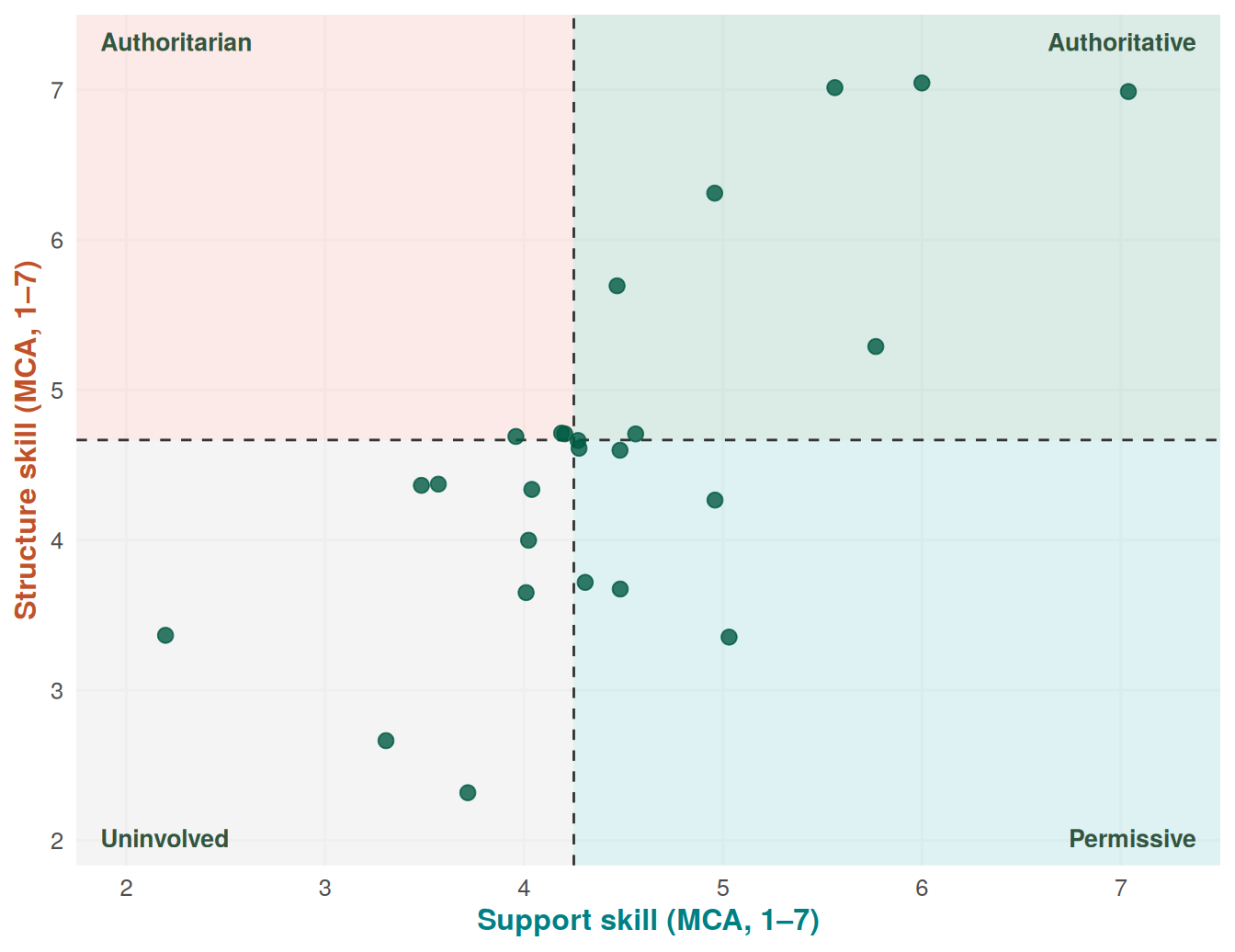
Each dot is one peer mentor. The dashed lines are the class medians on each skill, so “high” and “low” mean relative to your classmates. Find your Type in the table above, then find your quadrant.
Your type is a snapshot, not a fixed type
The median split means roughly a quarter of the class lands in each quadrant by construction. If you sit close to a dashed line, small changes in a few answers would move you. Each quadrant is a rough approximation of your balance between structure and support. This is not a fixed type! You can build skill on either dimension and move from one quadrant to another over time.
Reflect and Plan
Journal
- Score: How does reflecting on your score help you think about who you are as a mentor?
- Behavior: To be the best mentor you can be, what is one new thing you will try to do this week for mentees and/or your team?