| Password | Competing | Competing (%) | Collaborating | Collaborating (%) | Compromising | Compromising (%) | Avoiding | Avoiding (%) | Accommodating | Accommodating (%) |
|---|---|---|---|---|---|---|---|---|---|---|
| Drug Discovery | ||||||||||
| AR0518 | 4.00 | 100% (high) | 5.00 | 88% (high) | 3.33 | 21% (low) | 2.67 | 46% (mid) | 3.67 | 54% (mid) |
| ES2006 | 2.33 | 33% (low) | 2.67 | 0% (low) | 3.00 | 8% (low) | 2.67 | 46% (mid) | 2.00 | 0% (low) |
| FR0313 | 3.67 | 88% (high) | 5.00 | 88% (high) | 4.33 | 62% (mid) | 3.00 | 75% (high) | 4.00 | 75% (high) |
| IS2006 | 3.33 | 67% (high) | 4.00 | 21% (low) | 4.00 | 50% (mid) | 3.33 | 96% (high) | 3.33 | 29% (low) |
| IT1112 | 3.67 | 88% (high) | 4.33 | 46% (mid) | 3.00 | 8% (low) | 2.67 | 46% (mid) | 3.00 | 17% (low) |
| JK0901 | 2.33 | 33% (low) | 4.67 | 71% (high) | 3.67 | 29% (low) | 3.00 | 75% (high) | 3.33 | 29% (low) |
| LC1234 | 3.33 | 67% (high) | 3.33 | 4% (low) | 3.00 | 8% (low) | 1.00 | 0% (low) | 3.33 | 29% (low) |
| NA1029 | 2.33 | 33% (low) | 5.00 | 88% (high) | 4.33 | 62% (mid) | 2.33 | 12% (low) | 4.33 | 88% (high) |
| NK7306 | 1.33 | 0% (low) | 4.33 | 46% (mid) | 4.33 | 62% (mid) | 2.33 | 12% (low) | 4.00 | 75% (high) |
| PH0513 | 1.67 | 4% (low) | 4.33 | 46% (mid) | 2.67 | 4% (low) | 2.33 | 12% (low) | 3.00 | 17% (low) |
| TO8721 | 2.33 | 33% (low) | 3.33 | 4% (low) | 2.33 | 0% (low) | 2.67 | 46% (mid) | 3.67 | 54% (mid) |
| Environmental Visualization | ||||||||||
| AD0517 | 2.00 | 17% (low) | 3.67 | 12% (low) | 3.67 | 29% (low) | 2.33 | 12% (low) | 3.00 | 17% (low) |
| AS6699 | 3.67 | 88% (high) | 4.00 | 21% (low) | 3.67 | 29% (low) | 2.67 | 46% (mid) | 3.33 | 29% (low) |
| DA0427 | 2.00 | 17% (low) | 4.67 | 71% (high) | 4.33 | 62% (mid) | 3.00 | 75% (high) | 4.00 | 75% (high) |
| EL4269 | 2.67 | 58% (mid) | 4.00 | 21% (low) | 4.00 | 50% (mid) | 3.00 | 75% (high) | 2.67 | 8% (low) |
| GA0622 | 2.33 | 33% (low) | 4.33 | 46% (mid) | 4.33 | 62% (mid) | 3.00 | 75% (high) | 4.33 | 88% (high) |
| NT4456 | 2.00 | 17% (low) | 5.00 | 88% (high) | 4.33 | 62% (mid) | 2.33 | 12% (low) | 3.67 | 54% (mid) |
| SE1215 | 3.00 | 62% (mid) | 4.00 | 21% (low) | 4.00 | 50% (mid) | 2.33 | 12% (low) | 3.67 | 54% (mid) |
| TS1234 | 1.67 | 4% (low) | 4.67 | 71% (high) | 4.67 | 100% (high) | 2.33 | 12% (low) | 2.00 | 0% (low) |
| Public Health | ||||||||||
| LD0904 | 2.33 | 33% (low) | 4.67 | 71% (high) | 4.33 | 62% (mid) | 2.67 | 46% (mid) | 2.67 | 8% (low) |
| LE1709 | 3.33 | 67% (high) | 3.67 | 12% (low) | 4.33 | 62% (mid) | 1.67 | 4% (low) | 3.33 | 29% (low) |
| LE8134 | 1.67 | 4% (low) | 4.33 | 46% (mid) | 3.67 | 29% (low) | 1.67 | 4% (low) | 5.00 | 100% (high) |
| NH9122 | 3.33 | 67% (high) | 4.33 | 46% (mid) | 4.33 | 62% (mid) | 3.67 | 100% (high) | 4.67 | 96% (high) |
| NY1950 | 3.33 | 67% (high) | 4.00 | 21% (low) | 3.67 | 29% (low) | 2.67 | 46% (mid) | 3.67 | 54% (mid) |
| RE4743 | 2.00 | 17% (low) | 4.00 | 21% (low) | 3.33 | 21% (low) | 2.33 | 12% (low) | 3.33 | 29% (low) |
12. Conflict Style
What is my conflict resolution style?
The Mindset(s)
Conflict is simply the condition where two people’s concerns appear incompatible. It is not the same as fighting, and it is not automatically destructive. Two dimensions describe how you handle it: assertiveness (how far you try to satisfy your own concerns) and cooperativeness (how far you try to satisfy the other person’s). Crossing them gives five styles. No style is wrong. Each one works well in some situations and costs you in others.
- Competing: assertive and uncooperative. You pursue your own concerns at the other person’s expense.
- Survey item: “I push my own point of view.”
- Collaborating: assertive and cooperative. You look for a win-win that completely satisfies both people’s concerns.
- Survey item: “I examine issues until I find a solution that really satisfies me and the other party.”
- Compromising: intermediate on both. You find an acceptable solution that only partly satisfies both people’s concerns.
- Survey item: “I try to realize a middle-of-the-road solution.”
- Avoiding: unassertive and uncooperative. You sidestep the conflict without trying to satisfy either person’s concerns.
- Survey item: “I avoid confrontation about our differences.”
- Accommodating: unassertive and cooperative. You satisfy the other person’s concerns at the expense of your own.
- Survey item: “I give in to the wishes of the other party.”
Polarity: Win/Avoid ↔︎ Understand/Resolve, across five styles.
Measure: Dutch Test for Conflict Handling (DUTCH; De Dreu, Evers, Beersma, Kluwer & Nauta, 2001), short form. Fifteen items, three per style, rated 1 = Not at all to 5 = Very much. Each style is scored as the mean of its three items, so you get a profile across all five rather than a single label.
Find Your Score
Use your password to find your score(s).
Locate Your Score
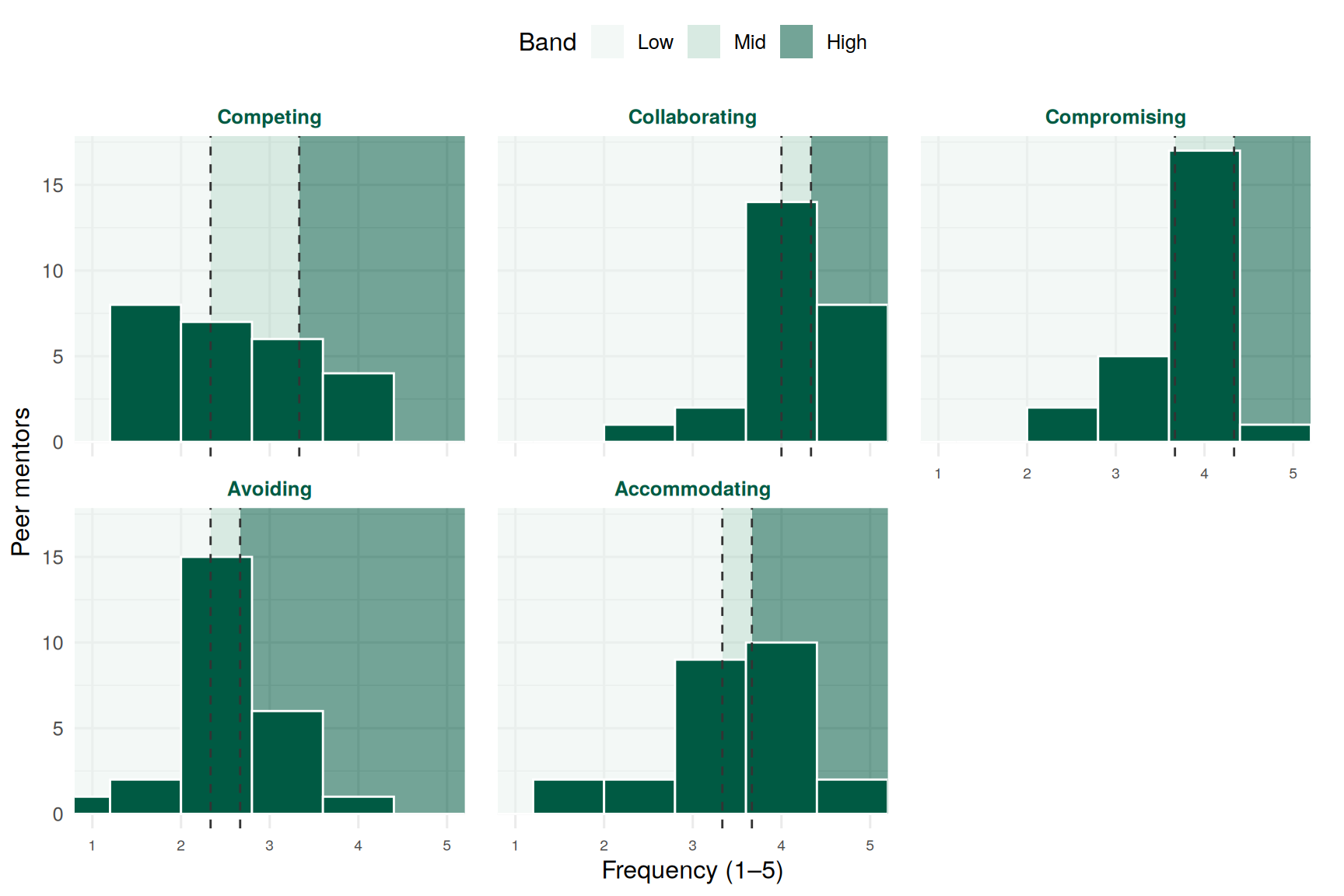
Locate your score(s) relative to other peer mentors!
Your Type
Your style below is the one you scored highest on relative to your cohort — your best percentile of the five, not your highest raw mean. Look up your password, then find that style in the table underneath to see when it serves you and when it costs you.
| Password | Style |
|---|---|
| Drug Discovery | |
| AR0518 | Competing |
| ES2006 | Avoiding |
| FR0313 | Competing & Collaborating |
| IS2006 | Avoiding |
| IT1112 | Competing |
| JK0901 | Avoiding |
| LC1234 | Competing |
| NA1029 | Collaborating & Accommodating |
| NK7306 | Accommodating |
| PH0513 | Collaborating |
| TO8721 | Accommodating |
| Environmental Visualization | |
| AD0517 | Compromising |
| AS6699 | Competing |
| DA0427 | Avoiding & Accommodating |
| EL4269 | Avoiding |
| GA0622 | Accommodating |
| NT4456 | Collaborating |
| SE1215 | Competing |
| TS1234 | Compromising |
| Public Health | |
| LD0904 | Collaborating |
| LE1709 | Competing |
| LE8134 | Accommodating |
| NH9122 | Avoiding |
| NY1950 | Competing |
| RE4743 | Accommodating |
This is your strongest style, not your only one
The DUTCH gives you a profile across all five, and the scores above show you use every one of them to some degree. The style named here is simply the one that stands out most against your peers. It is not a personality label, and a different situation may well call for a different mode.
Every mode has benefits and costs. The skill is knowing when to use each one, not defaulting to a favorite.
| Style | Works well when | Costs you when |
|---|---|---|
| Competing | The issue is critical, you are clearly right, or a fast decision is needed | Overused: strained relationships, worse decisions, less buy-in from your team |
| Collaborating | The stakes are high enough to justify the time and both sets of concerns matter | The issue is trivial, or there is no time |
| Compromising | You need a workable answer quickly and both sides can give a little | It becomes the reflex, and nobody’s real concern gets met |
| Avoiding | The issue is minor, tempers are hot, or you need time to gather information | The problem festers and your mentees read the silence as indifference |
| Accommodating | You are wrong, the issue matters far more to them, or preserving the relationship is the priority | Your own concerns disappear and your credibility erodes |
On the measure
The five styles come from the Thomas-Kilmann Conflict Mode Instrument (TKI) framework. The TKI itself is commercially licensed, so this guide uses the DUTCH, a published and validated instrument covering the same five styles, drawn from concern-for-self and concern-for-others. Items are verbatim; the short form uses three of the four to five items per style, so reliability should be re-checked on this sample before results are reported anywhere beyond this guide.
Reflect and Plan
Journal
- Score: How does reflecting on your score help you think about who you are as a mentor?
- Behavior: To be the best mentor you can be, what is one new thing you will try to do this week for mentees and/or your team?