| Password | Task | Task (%) | Relational | Relational (%) | Preference |
|---|---|---|---|---|---|
| Drug Discovery | |||||
| AR0518 | 29 | 79% (high) | 21 | 12% (low) | Task-leaning |
| ES2006 | 24 | 25% (low) | 26 | 67% (high) | Relational-leaning |
| FR0313 | 29 | 79% (high) | 21 | 12% (low) | Task-leaning |
| IS2006 | 29 | 79% (high) | 21 | 12% (low) | Task-leaning |
| IT1112 | 25 | 38% (mid) | 25 | 50% (mid) | Balanced |
| JK0901 | 26 | 54% (mid) | 24 | 38% (mid) | Balanced |
| LC1234 | 30 | 92% (high) | 20 | 4% (low) | Task-leaning |
| NA1029 | 28 | 67% (high) | 22 | 25% (low) | Task-leaning |
| NK7306 | 22 | 4% (low) | 28 | 92% (high) | Relational-leaning |
| PH0513 | 25 | 38% (mid) | 25 | 50% (mid) | Balanced |
| TO8721 | 22 | 4% (low) | 28 | 92% (high) | Relational-leaning |
| Environmental Visualization | |||||
| AD0517 | 24 | 25% (low) | 26 | 67% (high) | Relational-leaning |
| AS6699 | 23 | 12% (low) | 27 | 79% (high) | Relational-leaning |
| DA0427 | 24 | 25% (low) | 26 | 67% (high) | Relational-leaning |
| EL4269 | 26 | 54% (mid) | 24 | 38% (mid) | Balanced |
| GA0622 | 23 | 12% (low) | 27 | 79% (high) | Relational-leaning |
| NT4456 | 20 | 0% (low) | 30 | 100% (high) | Relational-leaning |
| SE1215 | 25 | 38% (mid) | 25 | 50% (mid) | Balanced |
| TS1234 | 28 | 67% (high) | 22 | 25% (low) | Task-leaning |
| Public Health | |||||
| LD0904 | 31 | 100% (high) | 19 | 0% (low) | Task-leaning |
| LE1709 | 26 | 54% (mid) | 24 | 38% (mid) | Balanced |
| LE8134 | 30 | 92% (high) | 20 | 4% (low) | Task-leaning |
| NH9122 | 28 | 67% (high) | 22 | 25% (low) | Task-leaning |
| NY1950 | 25 | 38% (mid) | 25 | 50% (mid) | Balanced |
| RE4743 | 23 | 12% (low) | 27 | 79% (high) | Relational-leaning |
9. Leadership Role
What is my leadership role?
The Mindset(s)
Leading a team is not one job but many. Morgeson, DeRue & Karam (2010) describe team leadership as a set of distinct functions a leader can take on. This week you decide which of ten functions you see as your role as a peer mentor. They fall into two groups:
- Task leadership: getting the work done: planning, tracking, and training.
- Survey item: “As a peer mentor, it is my role to help them plan.”
- Relational leadership: supporting the people: monitoring, motivating, developing, and holding the team together.
- Survey item: “As a peer mentor, it is my role to motivate the team to excel.”
Polarity: Task ↔︎ Relational leadership.
Measure: Mentoring Leadership Functions inventory, adapted from Morgeson et al. (2010), Table 2. The stem is “As a peer mentor, it is my role to…” and you rate each of ten functions 1–10. You have a budget of 50 points to spread across the ten, so you have to prioritize which functions are most central to your role. Your Task and Relational scores are the total points you place on each group’s functions (out of 50).
- Task functions: help them plan · keep track of assignment due dates · train the team on specific research skills · provide feedback to teammates · evaluate the performance of the team
- Relational functions: monitor the group chat for help · motivate the team to excel · encourage team members to self-manage · resolve team conflict · build friendships
Find Your Score
Use your password to find your score(s).
How your Preference is decided
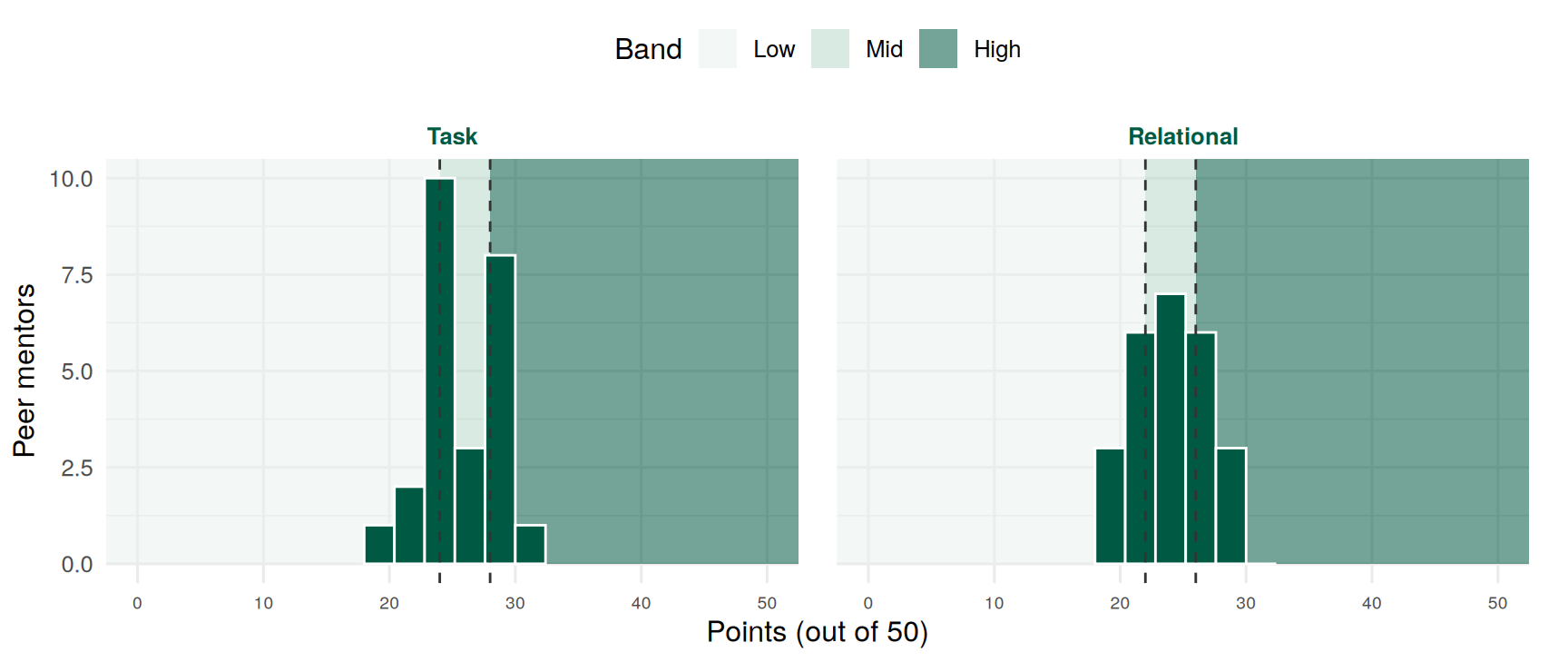
Your Preference comes from comparing your two percentiles. If your Task percentile sits more than 20 points above your Relational percentile you are Task-leaning; more than 20 points below, Relational-leaning; within 20 points of each other, Balanced.
The percentiles are used rather than the raw point totals because the 50 points are a fixed budget: judging against an even 25/25 split would say more about how the ten functions are worded than about how you see your role. Comparing percentiles asks which way you lean relative to your peers.
Locate Your Score
Locate your score(s) relative to other peer mentors!
About this measure
The ten functions are drawn from Morgeson, DeRue & Karam’s (2010) functional model of team leadership, but the mentoring-specific wording, the importance framing, and the 50-point budget are adapted for this course. Because the points are a fixed budget, spending more on one group of functions necessarily means spending less on the other, and the two totals always sum to exactly 50. Task and Relational cover five functions each, so the two scores are directly comparable — but still read each one against the cohort distribution above rather than against the scale. Because the two are complements, their percentiles always look like opposites: a high Task percentile forces a low Relational one. Re-check reliability before reporting results beyond this guide.
Reflect and Plan
Journal
- Score: How does reflecting on your score help you think about who you are as a mentor?
- Behavior: To be the best mentor you can be, what is one new thing you will try to do this week for mentees and/or your team?