| Password | Self-connection | Self-connection (%) | Authentic self-expression | Authentic self-expression (%) | Empathic listening | Empathic listening (%) | Strength |
|---|---|---|---|---|---|---|---|
| Drug Discovery | |||||||
| AR0518 | 3.5 | 38% (mid) | 3.5 | 50% (mid) | 3.00 | 4% (low) | Authentic self-expression |
| ES2006 | 2.5 | 8% (low) | 2.5 | 0% (low) | 3.67 | 58% (mid) | Empathic listening |
| FR0313 | 3.5 | 38% (mid) | 3.5 | 50% (mid) | 4.00 | 92% (high) | Empathic listening |
| IS2006 | 3.0 | 12% (low) | 3.0 | 12% (low) | 3.00 | 4% (low) | Self-connection & Authentic self-expression |
| IT1112 | 3.0 | 12% (low) | 2.5 | 0% (low) | 3.33 | 29% (low) | Empathic listening |
| JK0901 | 4.0 | 83% (high) | 4.0 | 79% (high) | 3.67 | 58% (mid) | Self-connection |
| LC1234 | 3.5 | 38% (mid) | 3.5 | 50% (mid) | 3.67 | 58% (mid) | Empathic listening |
| NA1029 | 4.0 | 83% (high) | 4.0 | 79% (high) | 4.00 | 92% (high) | Empathic listening |
| NK7306 | 4.0 | 83% (high) | 4.0 | 79% (high) | 4.00 | 92% (high) | Empathic listening |
| PH0513 | 3.0 | 12% (low) | 3.0 | 12% (low) | 3.33 | 29% (low) | Empathic listening |
| TO8721 | 3.5 | 38% (mid) | 3.0 | 12% (low) | 3.00 | 4% (low) | Self-connection |
| Environmental Visualization | |||||||
| AD0517 | 3.5 | 38% (mid) | 3.5 | 50% (mid) | 3.67 | 58% (mid) | Empathic listening |
| AS6699 | 3.5 | 38% (mid) | 4.0 | 79% (high) | 3.00 | 4% (low) | Authentic self-expression |
| DA0427 | 4.0 | 83% (high) | 3.0 | 12% (low) | 3.33 | 29% (low) | Self-connection |
| EL4269 | 3.5 | 38% (mid) | 2.5 | 0% (low) | 3.00 | 4% (low) | Self-connection |
| GA0622 | 3.5 | 38% (mid) | 3.0 | 12% (low) | 3.00 | 4% (low) | Self-connection |
| NT4456 | 3.5 | 38% (mid) | 3.0 | 12% (low) | 3.33 | 29% (low) | Self-connection |
| SE1215 | 2.0 | 0% (low) | 4.0 | 79% (high) | 3.67 | 58% (mid) | Authentic self-expression |
| TS1234 | 3.0 | 12% (low) | 3.5 | 50% (mid) | 3.33 | 29% (low) | Authentic self-expression |
| Public Health | |||||||
| LD0904 | 4.0 | 83% (high) | 3.5 | 50% (mid) | 3.67 | 58% (mid) | Self-connection |
| LE1709 | 2.0 | 0% (low) | 3.5 | 50% (mid) | 2.67 | 0% (low) | Authentic self-expression |
| LE8134 | 3.5 | 38% (mid) | 3.0 | 12% (low) | 3.67 | 58% (mid) | Empathic listening |
| NH9122 | 3.0 | 12% (low) | 4.0 | 79% (high) | 3.33 | 29% (low) | Authentic self-expression |
| NY1950 | 3.0 | 12% (low) | 3.0 | 12% (low) | 3.33 | 29% (low) | Empathic listening |
| RE4743 | 3.5 | 38% (mid) | 3.0 | 12% (low) | 3.67 | 58% (mid) | Empathic listening |
10. Communication Style
What is my communication style?
The Mindset(s)
Nonviolent Communication describes three behaviors that keep a hard conversation connected rather than combative.
- Self-connection: recognizing that your emotions come from your own thoughts and unmet needs, and staying present enough under stress to notice a reaction without acting on it.
- Survey item: “Knowing that my emotions stem from my own thoughts and unmet needs, my emotions are not caused by others.”
- Authentic self-expression: stating your feelings, needs, and requests sincerely, without accusation, and staying open to any response.
- Survey item: “Being responsible for my own experience, and willing to express my feelings and needs sincerely without accusation or criticism.”
- Empathic listening: staying open and flexible, and using conflict to connect rather than to win.
- Survey item: “Listen patiently, try to understand other people from their perspective.”
Polarity: Violent ↔︎ Nonviolent.
Measure: Nonviolent Communication Behaviors Scale (Cheung et al., 2022). Seven items rated 1 = Never to 4 = Frequently.
Find Your Score
Use your password to find your score(s).
What “Strength” means here
Your Strength is whichever of the three behaviors sits highest against your cohort — your best percentile of the three, not your highest raw score. The three subscales are built from different numbers of items and spread differently, so comparing raw means across them would mostly describe the scales rather than you.
It is a relative strength, so everyone has one. It does not say you are strong on that behavior and weak on the others, and it does not say the other two need fixing. Read it as the place you already have something to build from.
Locate Your Score
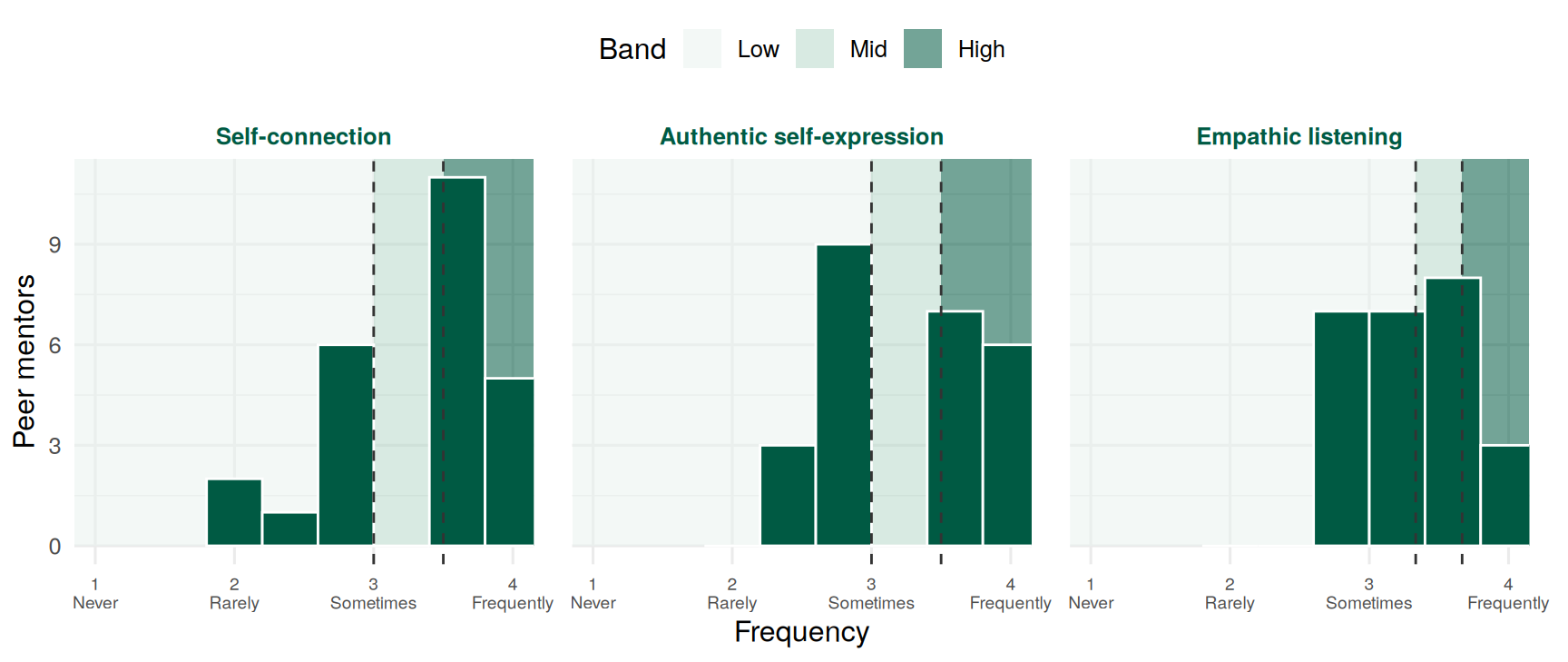
Locate your score(s) relative to other peer mentors!
The Three Dimensions Together
Nonviolent communication is not one scale but three habits working together. This plot places each peer mentor in the space defined by all three at once. Drag to rotate it and see how self-connection, authentic self-expression, and empathic listening relate; hover a point to see its password.
Reflect and Plan
Journal
- Score: How does reflecting on your score help you think about who you are as a mentor?
- Behavior: To be the best mentor you can be, what is one new thing you will try to do this week for mentees and/or your team?